|
 |
| Home |
| About Orkney |
| History |
| Tradition |
| Folklore |
| Placenames |
| Images |
| Downloads |
| About the Site |
| Contact |
| Links |
| Search Site |
| Awards |
 |
|
| A Brief History of Orkney | |
|
|
|
The Neolithic - 4000-2500BC By this time the bands of hunter-gatherers of the Mesolithic had adopted agriculture and small groups of farmers were making their way across the Pentland Firth from northern and western Scotland to settle in the fertile islands. As farmers, the nomadic lifestyle of the Mesolithic had to cease as the raising of crops required permanent settlements in areas of good soil. But despite the importance of agriculture, the people of the Neolithic still relied on hunting and fishing to survive. The daily way of life of these early farmers can be gleaned from the remains of their houses, burial places and monuments, as well as the less grand, but equally important, materials such as pottery, tools and refuse. Places such as the Knap of Howar on Papay and Skara Brae on the western shores of the Orkney Mainland give clear insights into the domestic lives of the farming communities. At the Knap of Howar, for example, the bones of domesticated cattle, sheep and pigs were found alongside those of wild deer, whales and seals.
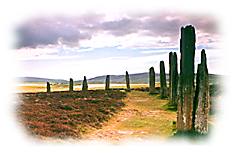
Their tradition of burials within chambered cairns such as Cuween, Wideford and Quanterness also gives tantalising glimpses of these early Orcadians, their beliefs and customs. Cairns were an essential part of life to the early farmers with the remains of men, women and children - but not all - placed within the chambered tombs they erected throughout Orkney. Over the years it seems the small farming communities gradually developed into larger units - communities that were capable of constructing the major monuments such as Maeshowe and the Ring of Brodgar. From around 3500BC the "heartland" of the Orkney Mainland - the area surrounding the lochs of Stenness and Harray - appears to have become a ceremonial meeting place, a role it maintained for millennia. |
 |